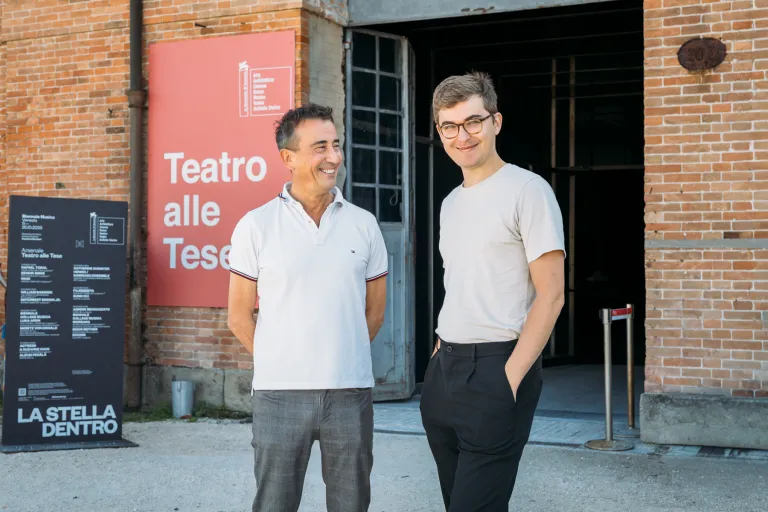

For the past four years, HOLOPHONIX has been redefining the soundscape of La Biennale di Venezia – Biennale Musica, bringing immersive sound to the forefront of Venice’s artistic landscape. This year, under the artistic guidance of Thierry Coduys, internationally renowned sound designer and mentor, and the technical expertise of assistant sound designer Adrien Zanni, the festival’s spaces are transformed into multidimensional environments where sound interacts with architecture and becomes a narrative in its own right.
Our mission is to go beyond traditional stereo. We want the Biennale to offer an experience where sound moves around you, tells a story, and blends with the performance and the space,
explains Thierry.
This vision takes form through the HOLOPHONIX ecosystem, which allows artists and technicians to sculpt sound that envelops the audience.
A highlight of this year’s Biennale is the tribute to the legendary Italian artist Franco Battiato, a visionary composer whose work spans electronic and experimental music, progressive rock, opera, and meditative pop. For this installation, a 28-speaker system was deployed across three stages: classical, jazz/ethno-fusion, and the main performance space. This setup demonstrates how an ambitious immersive design can be achieved even with limited resources. As an agnostic spatial audio processor, HOLOPHONIX can pilot any brand of loudspeakers, and in Venice the system was seamlessly integrated with d&b audiotechnik models to shape the immersive experience.
The main LCR system combined CCL8 and CCL12 loudspeakers with each left and right cluster comprising two CCL8 and two CCL12, and the center cluster using two CCL8. The classical and ethno-fusion stages, both operating in stereo, each featured two CCL8 and two CCL12 per side. Surround coverage was created with 24 d&b E8 loudspeakers forming a ring around the audience, complemented by 4d&b E8 in zenithal positions. Low-frequency output was delivered through 8 d&b XSL subwoofers in infra mode.
Thierry Coduys reflects:
Battiato ’s music demanded an approach as innovative as his compositions. HOLOPHONIX allows us to honor his legacy while creating something entirely new for the audience. His work pushes us to explore new ways of shaping space and emotion through sound, all brought to life through the HOLOPHONIX spatial audio processor.
The Biennale also showcases the work of international emerging artists such as Jasmin Morris and Luka Aron, whose installations blend visual and auditory elements to create fully enveloping experiences. Aron’s project, in particular, highlights the potential of HOLOPHONIXto merge performance, architecture, and electronics into a seamless sonic journey. Jasmin Morris brings a fresh perspective, using the HOLOPHONIX system to explore textures, timbres, and spatial dynamics that transform audience perception.
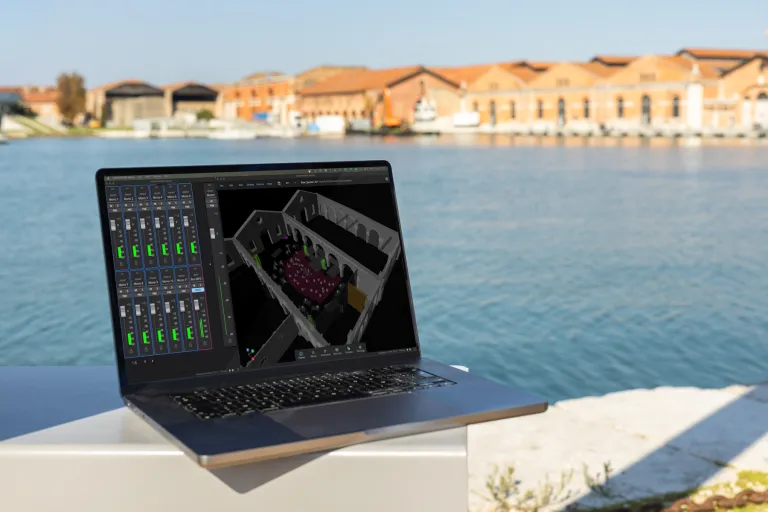
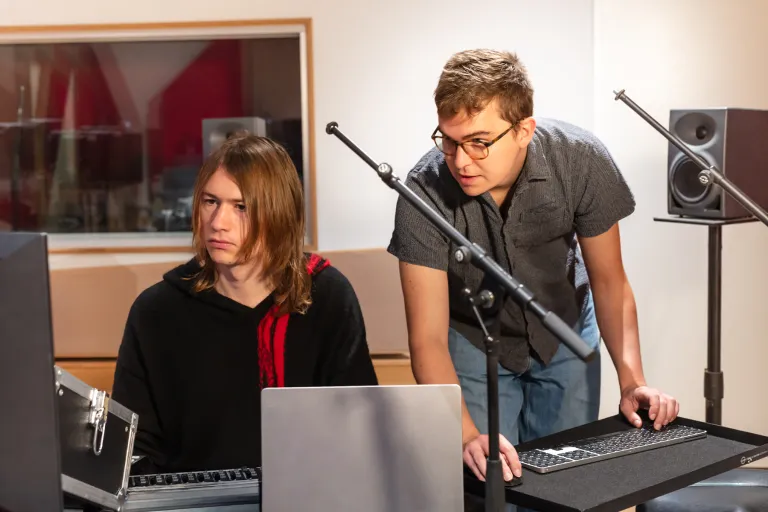
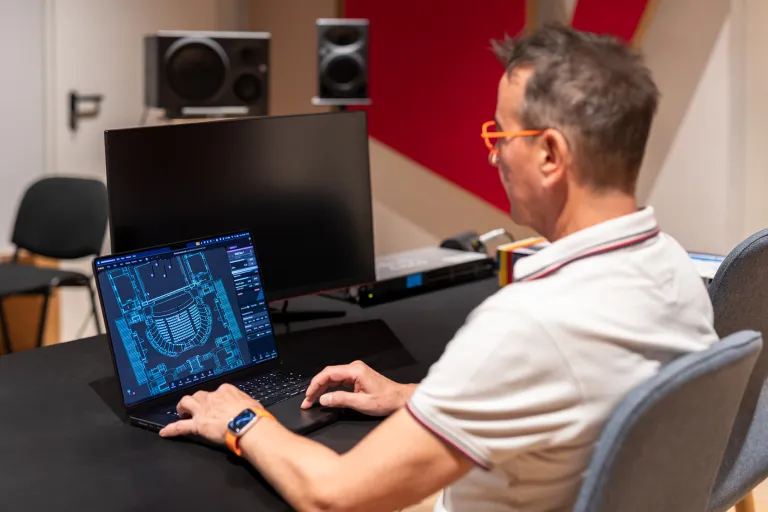
Much of this work begins in the studio, where artists prototype their pieces using HOLOPHONIX Native, with virtual soundcards, 3D venue plans, and binaural monitoring to anticipate acoustic challenges. Adrien Zanni describes this as a uniquely streamlined method:
With HOLOPHONIX , we can model the entire system before arriving on-site. It’s a unified workflow from pre-production to calibration, allowing us to shape the spatial behavior with great precision.
Once on location, the real-world architecture of Venice requires constant adaptation. HOLOPHONIX’s flexibility becomes essential.
The system allows us to recalibrate instantly for the actual speaker positions. In Venice, every venue is unique, so the ability to control and adjust everything remotely is crucial,
says Adrien Zanni.
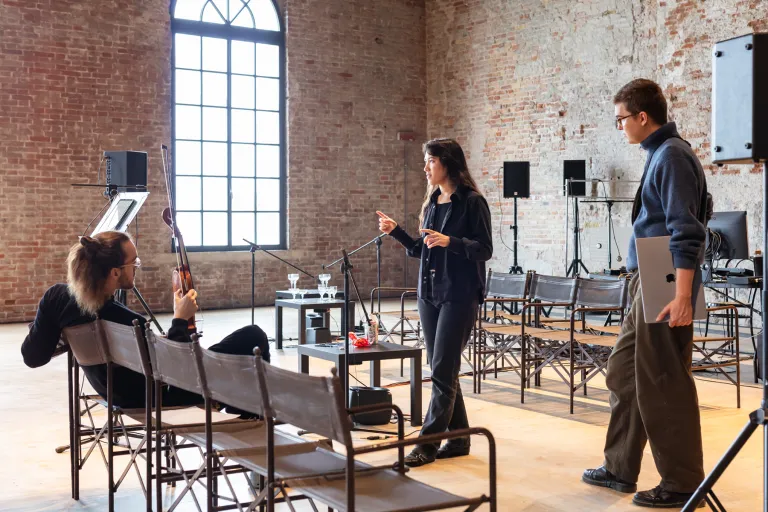
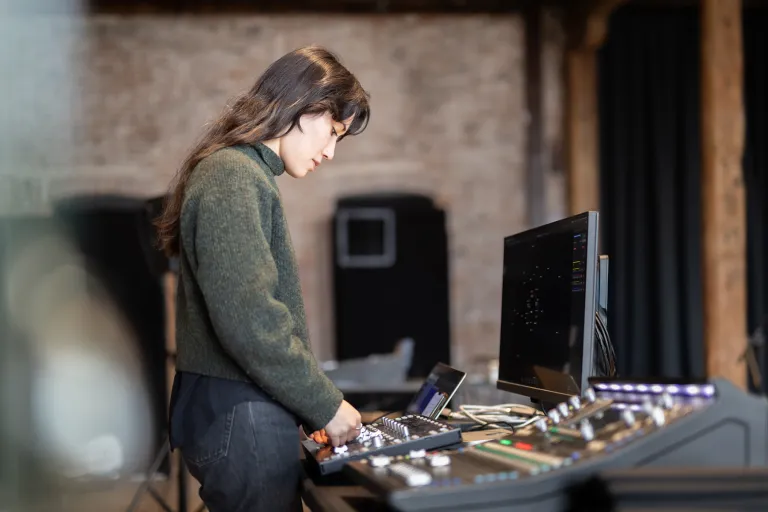
Beyond technical operations, the heart of the Biennale lies in artistic mentorship. Adrien supports composers throughout their residency, encouraging them to treat spatialization as an integral part of the writing process.
I put the tool in their hands as soon as possible so they can make it their own. Writing sound in space is as essential as writing melody or rhythm. We need tools like HOLOPHONIX that allow this level of expression,
he explains.
As the festival continues to evolve, HOLOPHONIX deepens its role within it. Each edition serves as a space for refining processes, developing new tools, and imagining future possibilities, solidifying the festival as a platform for continuous research and innovation.
From workshops to high-profile performances, HOLOPHONIX’s footprint at the Venice Biennale is a testament to the transformative power of sound. As Thierry Coduys concludes,
Our work isn’t just about technology, it’s about creating an emotional, spatial experience that changes how people perceive music. This is what makes HOLOPHONIX essential to the Biennale and to the future of immersive art.