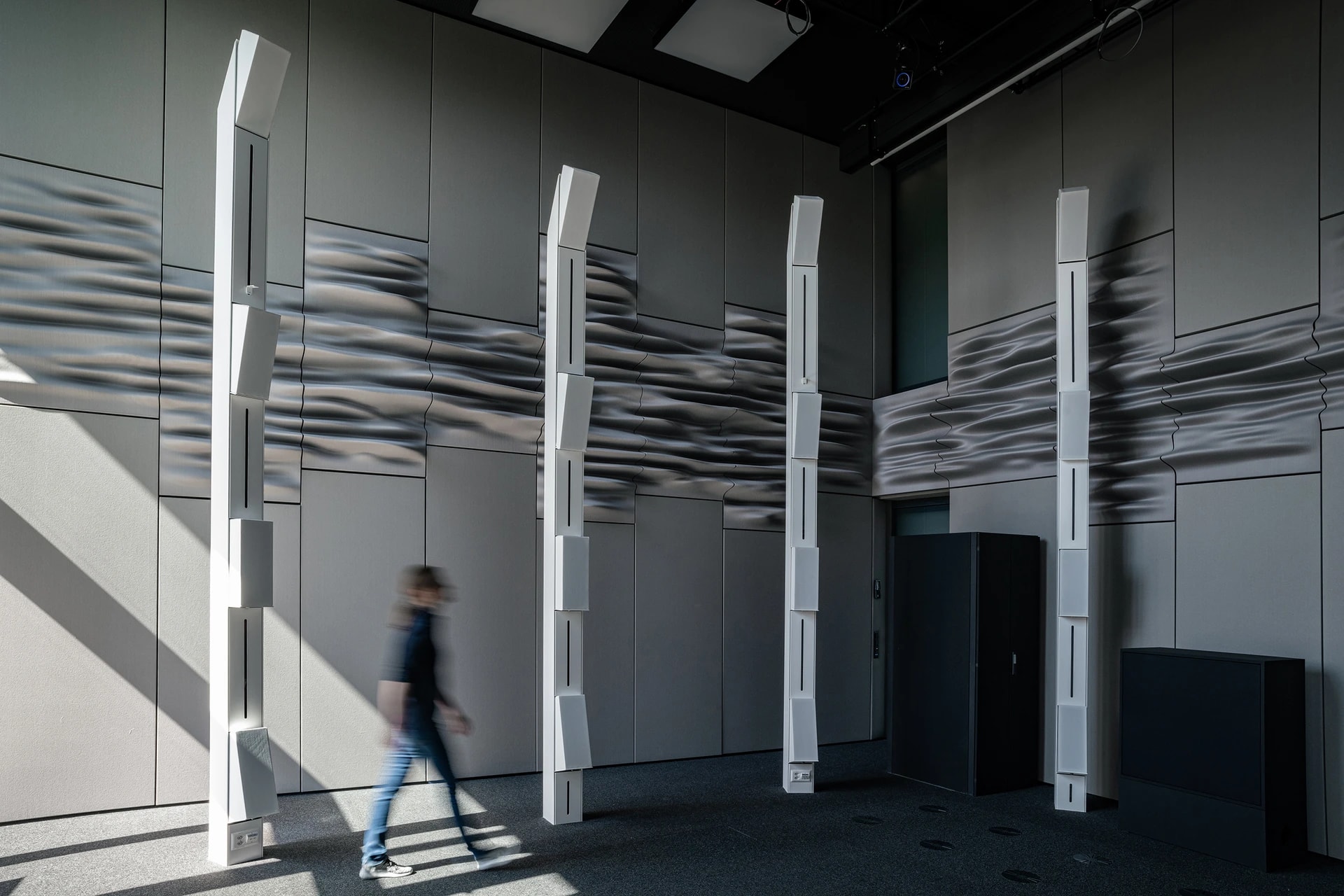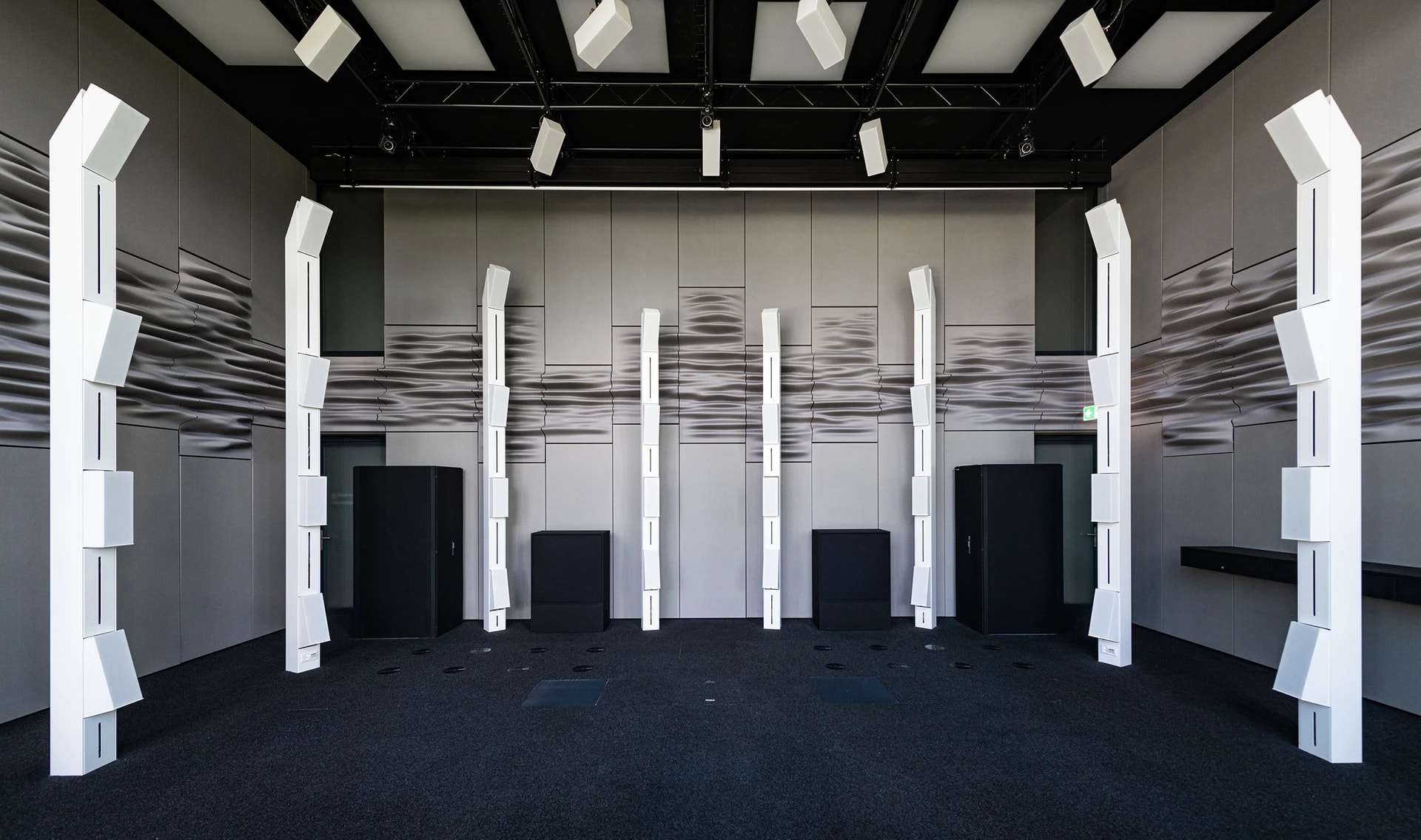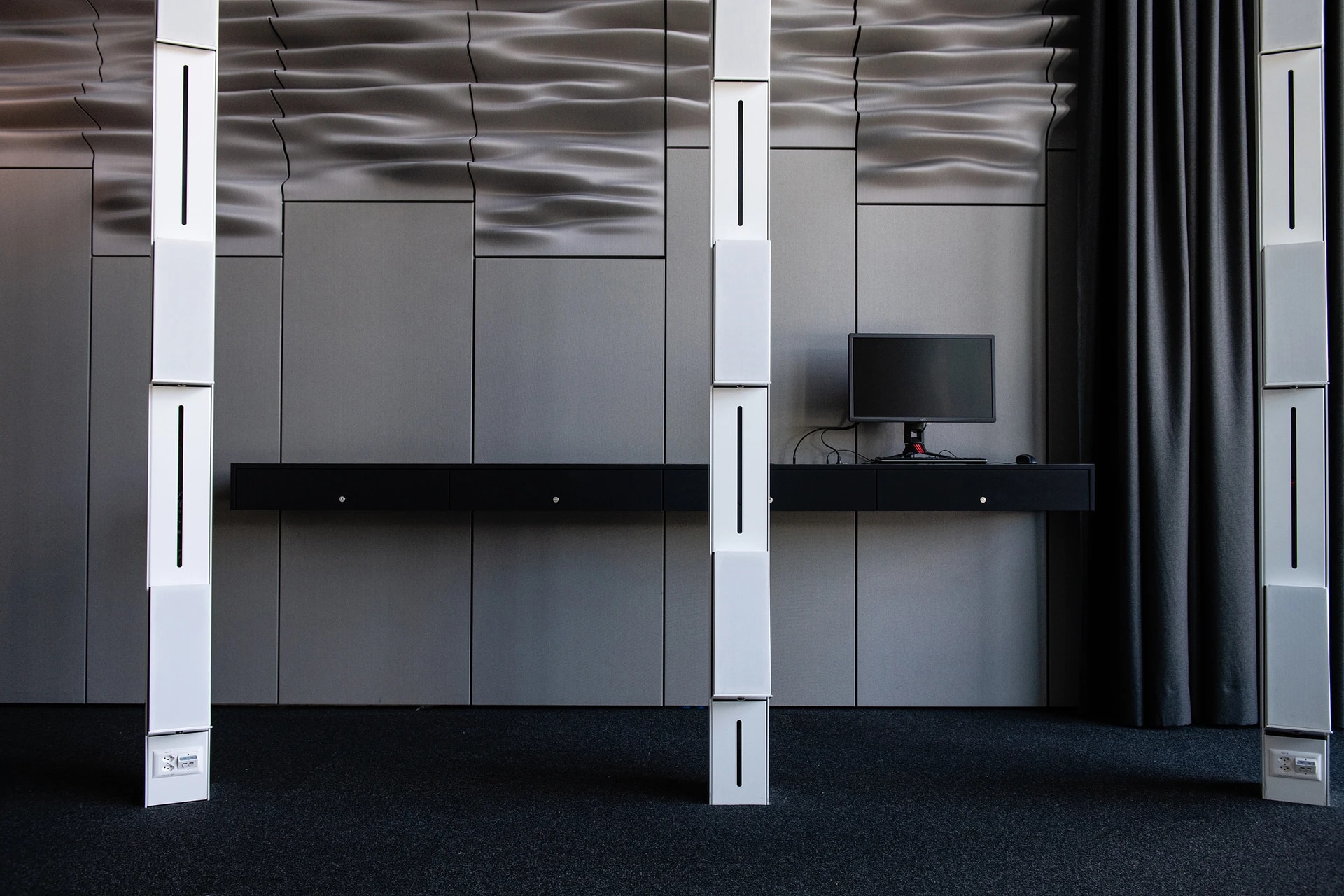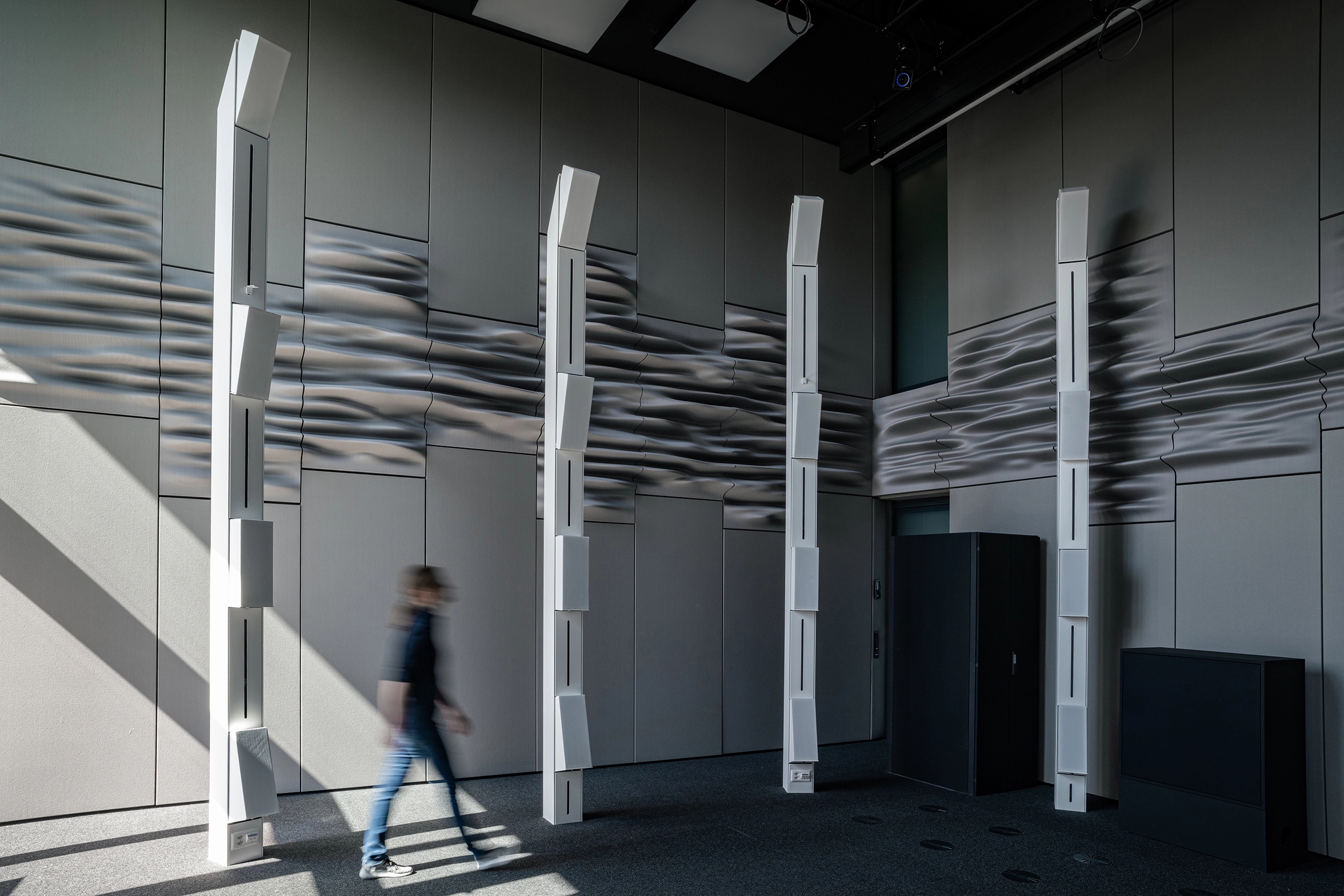
On the Hönggerberg campus of ETH Zürich, architects, engineers and students can step inside buildings that do not yet exist and experience how they sound.
The Immersive Design Lab is the flagship infrastructure of Design++, ETH Zürich’s Center for Augmented Computational Design in Architecture, Engineering and Construction. Designed by Gramazio Kohler Research and completed in 2021, the 32-square-metre circular arena combines spatial audio, projection and motion tracking to create an immersive environment for architectural research and education.
At the heart of the lab is a 75-loudspeaker spatial audio system driven by HOLOPHONIX, conceived to allow researchers to explore not simply how a virtual space looks, but how it sounds.
Designing an immersive listening environment
The loudspeaker configuration was developed by ETH Zürich, with Amadeus contributing spatial audio expertise during the design process. Candidate layouts generated computationally by ETH were evaluated and refined to determine the density and distribution required for accurate three-dimensional sound reproduction.
The final configuration surrounds a critical listening area approximately five metres across with 75 independently controlled loudspeakers: four integrated into the floor, 56 distributed across four elevation levels around the arena, 14 mounted on a dedicated ceiling structure, and one positioned at the zenith.
Extending both above and below the listener, the array allows HOLOPHONIX to position and move virtual sound sources throughout the three-dimensional listening environment, including at low elevations that are rarely represented in conventional spatial audio systems.
The loudspeaker setup looks really good. With such a high number of channels, the coverage will be really great, and it is a good thing to have loudspeakers in the floor and in low elevations,
commented Thibaut Carpentier, researcher at IRCAM, when reviewing the final configuration.
The system was designed around a standing reference listener at a height of 1.71 metres, reflecting the way the laboratory is used. Rather than remaining seated in a fixed listening position, up to twenty participants can move throughout the arena and interact with virtual architectural environments.
The loudspeakers were designed and manufactured specifically for the lab by Strauss Elektroakustik in Bern, which also carried out the system tuning. Arcad Audio completed the audio integration, with the system powered by sonible d:24 multichannel amplifiers.
A laboratory for spatial sound
HOLOPHONIX provides the spatial audio engine at the centre of the laboratory, driving all 75 loudspeaker channels over Dante and allowing researchers to work with multiple spatialisation techniques within the same environment.
For a research environment, the ability to work with different spatialisation techniques within a single platform is fundamental. HOLOPHONIX integrates multiple rendering approaches, including Wave Field Synthesis (WFS), Higher-Order Ambisonics (HOA), VBAP, VBIP, DBAP and KNN.
Researchers can therefore explore and compare different methods using the same loudspeaker configuration and acoustic environment, turning the spatial audio system itself into a research tool.
The system was commissioned in July 2021, followed by on-site HOLOPHONIX training bringing together acousticians, systems integration specialists and architects — reflecting the interdisciplinary approach at the core of the Immersive Design Lab.
Hearing architecture before it exists
From the earliest stages of the project, ETH Zürich was interested in moving beyond source localisation towards the simulation of architectural acoustics: could architects experience the reverberation and acoustic character of a room while it still existed only as a design?
With HOLOPHONIX 2.4, released in 2026, that possibility has expanded through the introduction of the Convolution Reverb Engine. The engine can load and process Ambisonics impulse responses of up to 64 channels, equivalent to seventh-order Ambisonics, enabling measured or simulated acoustic environments to be reproduced through the existing HOLOPHONIX infrastructure.
For architectural research, this opens the possibility of evaluating acoustic decisions alongside visual and spatial ones, experiencing how changes to geometry or materials may influence a space before construction begins.
The Immersive Design Lab is in frequent use, and the use of the audio system is ramping up as well. We started a course entitled Architectural Acoustics, dedicated to bringing the topic closer to architecture students. The listening examples used in the course and the student works all use the lab’s spatial audio system,
explains Professor Matthias Kohler, ETH Zürich.
The installation brings architectural acoustics out of drawings, simulations and numerical data and into an environment that can be directly experienced. At ETH Zürich, spatial audio becomes not simply a means of reproducing sound, but a tool for designing with sound, allowing architects, researchers and students to listen to spaces before they are built.
System
Spatial audio processing: HOLOPHONIX
Loudspeaker system: 75 custom Strauss Elektroakustik loudspeakers
Configuration: 4 floor · 56 across four elevation levels · 14 ceiling · 1 zenith
Amplification: sonible d:24
Audio network: Dante
Integration: Arcad Audio
Motion tracking: 10 × OptiTrack cameras
Architecture and acoustic surfaces: Gramazio Kohler Research