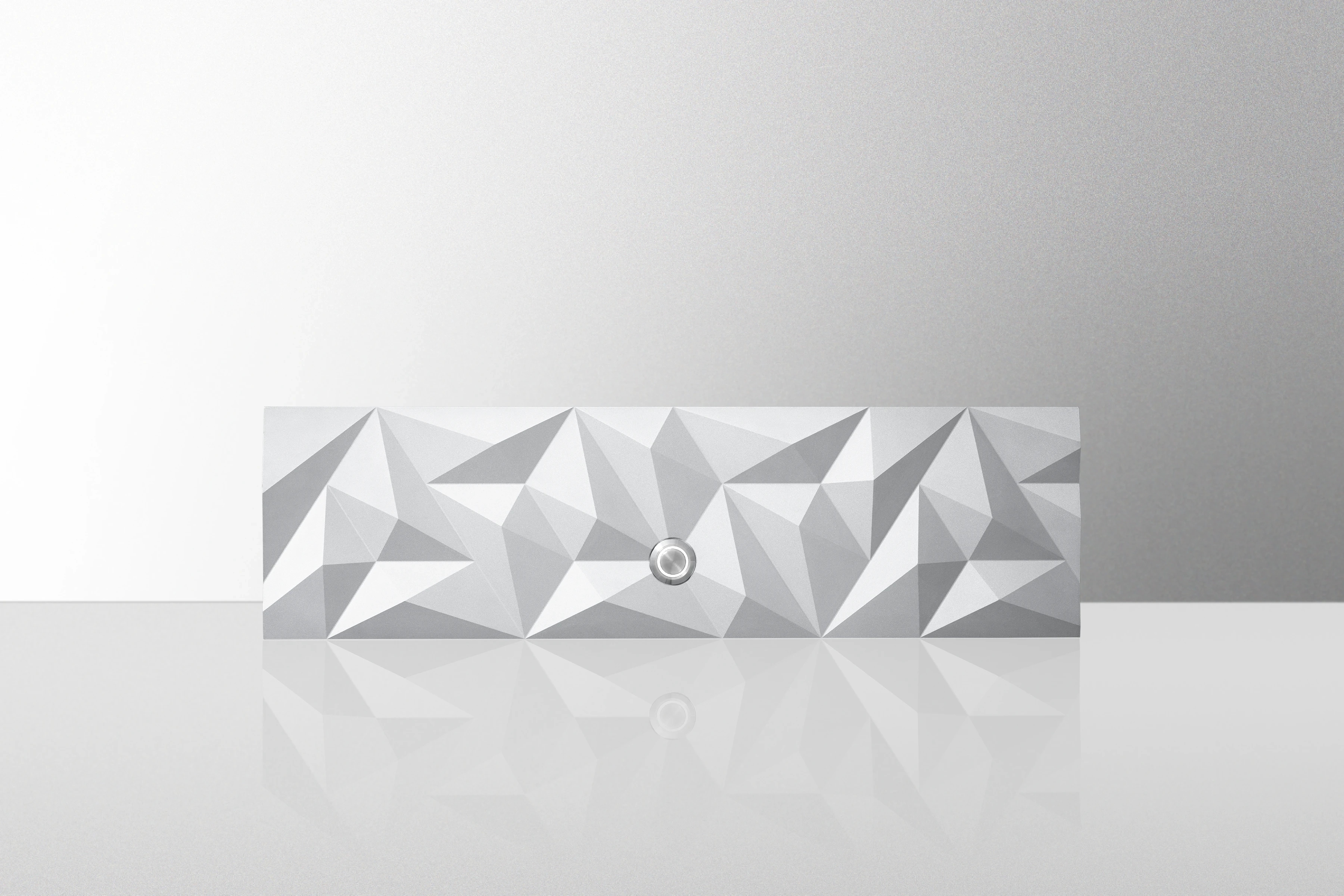
HOLOPHONIX 64
HOLOPHONIX 64, Offering Up to 128 Inputs, and 64 Outputs
Dante Spoken !
The HOLOPHONIX Audio over IP protocol is Dante-based and can be integrated with a wide range of standard commercial Digital Audio Workstations (DAW) and Dante-enabled devices, providing an additional layer of control.
A Sound-breaking Design
HOLOPHONIX 64 revolutionized the industry with its style and manufacturing process. Embodying HOLOPHONIX's precision and functional craftsmanship, this machined aluminum processor features a structure inspired by modern architecture and the intricate patterns of scientific diagrams. Its compact dimensions conceal a powerful and optimized electronic design.
Reliable Support
The HOLOPHONIX support team is available to assist professionals in solving any problems they may encounter with our products. If necessary, a Service Mode feature can be activated, enabling our support team to remotely access the HOLOPHONIX Ultra processor for control or repair purposes at any time (requires an Internet connection).
Specifications techniques
HOLOPHONIX 64
Hauteur: 2U, 9011 mm
Largeur: 344 mm
Profondeur: 338 mm
Connecteur secteur: 1 x powerCON
Type d'entrée: 100-240V AC, 50/60 Hz
Puissance totale: 550W
Format: Dante® AoIP Network
Canaux audio: 128 x 64 redundant channels maximum (depending on the licence charged)
Fréquences d'échantillonnage: 44.1, 48 kHz, 88.2, 96 kHz
Résolution: 24 bits PCM
Latence: < 2 ms
Tailles de buffer: 32, 64, 128, 256, 512, 1024, 2048 samples
Configuration: via Dante Controller App
USB: 1 × USB 3.0 (Type A)
Port service: 1 x HDMI Port
Connexions: 2 × etherCON (2.5 Gbps) Ethernet Ports (Primary and Secondary)
1 × etherCON Remote Port (1 Gbps)
2 × etherCON Dante Ports (2.5 Gbps)
Real-time automation capabilities thanks to the 'HOLOSCORE' free plug-in, compatible with any major DAW
Compatible with the Open Sound Control (OSC) protocol
Fully automated reboot after power outage
‘HOLOPHONIX Designer’ free offline editor for macOS® and Windows®
Unlimited (user-defined)
Unlimited (user-defined)
Mono, Stereo, Multichannel (user-defined layouts and channel quantity)
A-Format, B-Format, HOA Stream, Zylia, Eigenmike
Direct input routing to Master (without spatial algorithm processing)
WFS (Wave Field Synthesis) 2D, and 3D
HOA (Higher Order Ambisonics) 2D, and 3D, up to 7th order Ambisonics
VBAP (Vector-Base Amplitude Panning) 2D, and 3D
VBIP (Vector-Base Intensity Panning) 2D, and 3D
LBAP (Layer-Based Amplitude Panning) 3D
KNN (K Nearest Neighbors) 2D, and 3D
Angular 2D
Stereo Panning, Stereo AB, Stereo XY
Binaural for headphones
Transaural for stereophonic loudspeaker system
Support of head tracking and SOFA HRTF files for binaural and transaural algorithms
Free loudspeaker positioning to fit any custom loudspeaker layout
Outputs can also be configured to standard output formats (for example, to record an automatic downmix of the performance) :
Channel-based setup : any ITU standard (e.g. 5.1, 7.1, 22.2, etc.), stereo panning, AB/XY microphone simulation for more realistic results, or binaural
Scene-based setup : higher order Ambisonics from 1st order (B-Format) to very high resolution 7th order, compatible with many decoding software and VR applications such as YouTubeTM VR and FacebookTM 360
3D-immersive algorithmic reverberation
Object-based simulation and independant control on direct sound, early reflections and late reverberation parameter
Automatic level option based on source positioning and distance Model based on perceptive studies of distance
Trim (-80, +30dB) and Level (-60, +12dB) adjustments for sources, buses and master
Adjustable delay (0 to >5000 ms) on sources and buses
Equalizer and dynamic processing options on each source, bus, reverberation, with eight fully adjustable bands: 4 × Parametric filters (2d order), HPF and LPF filters (Butterworth type), High Shelf and Low Shelf filters available
Equalizer available on each audio output (loudspeaker)
Loudspeaker gain and delay adjustment on each spatialization bus, individually (with automatic computation mode based on loudspeaker positioning)
Integrated binaural monitoring of the loudspeaker setup
LFE channel with adjustable HPF filter (2nd order IIR filter, 12 db/oct) or user-defined subwoofer bus, using any available algorithm
Fully automated booting procedure, with a user-definable preset automatically loaded at startup, for easy operation on basic setups
Export 3D: GLB
Import 3D: GLB, STL, OBJ
Redondance: Glitch-free audio redundancy with Primary and Secondary Ethernet ports
Embedded tech support tools for remote troubleshooting
Local control (with a computer screen, keyboard and mouse, not provided) exclusively authorized for service and maintenance.